Flight 15
Starship: ten hours in orbit, booster splashes down, first ship catch still ahead
The booster is gone, but Flight 15’s hardest test is still ahead: bringing Ship 42 back from orbit into the tower’s arms.
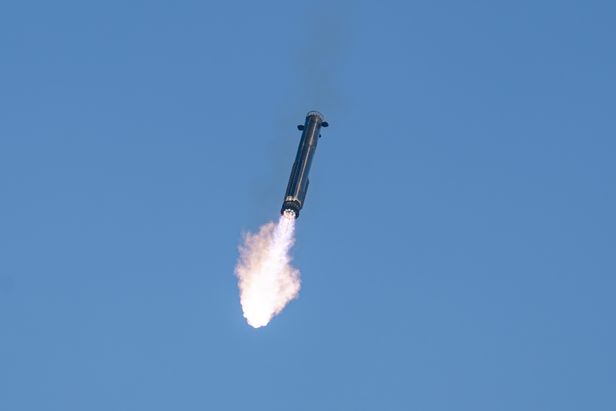
SpaceX’s Starship Flight 15 lifted off successfully from Starbase, Texas, on November 13, pairing Super Heavy Booster 22 with Ship 42. At the time of writing, the ship has been in orbit for about ten hours, awaiting its scheduled return and the first attempt to catch it with a landing tower’s arms. The planned double recovery is already off the table: the booster didn't make it back to Mechazilla.
In an update on its official webcast, SpaceX said B22’s catch was aborted because of a problem with the booster’s own guidance, navigation and control system, or GNC. Instead of approaching the tower, it made a controlled splashdown in the Gulf of Mexico and then exploded. It completed the landing maneuver over water, but there is no booster left to reuse. Keeping the tower intact is especially important with the harder half of the test still ahead.
On the previous flight, Starship reached Earth orbit for the first time, deployed Starlink V3 satellites and returned to the Pacific. A vacuum engine failed during ascent, prompting SpaceX to end that mission after three hours and eight minutes rather than the nearly ten hours planned. Ship 42 has already outlasted its predecessor in orbit. Its intended destination is now a landing tower in Texas.
Under SpaceX’s flight plan, the ship is due to return for a catch roughly 22.5 hours after launch. Ten hours in orbit is therefore well within the planned timeline. Clearance to return to Starbase depends on checks of the systems needed for atmospheric reentry, the landing burn and the approach to the tower. If those checks fall short, the fallback is a Pacific splashdown.
Catching the ship is harder than catching the booster. Returning at orbital speed, it must survive reentry heating, maintain control, then flip upright and ignite its engines in time to line up precisely with the tower’s arms. Nearly a day in space also tests whether its onboard systems and engines remain ready for the return. Space.com reports that the mission includes three contingency checkpoints at which SpaceX can opt for an early return to the Pacific.
“More likely than not” — Elon Musk on the first ship catch
Elon Musk has put the chances of a successful first catch at “more likely than not”. That is the SpaceX chief’s assessment; the sources reviewed for this story contain no published engineering calculation of the odds. Clayton Swope, an aerospace expert at the Center for Strategic and International Studies, calls full reusability the space industry’s “Holy Grail”. No one has yet achieved it in the form SpaceX envisages. Flight 15 tackles one of the toughest remaining steps.
A successful S42 catch could still make this a breakthrough flight: for the first time, a Starship would return from orbit into the tower’s arms, available for reuse. The next test would be preparing it to fly again—and actually launching it. Reusability starts paying off when the same hardware makes repeat flights. First, SpaceX has to bring this ship home.
Imagerly.Ai · No. 44 · November 2026