Enterprise agents
Salesforce Hands Claude the Interface. The Risk Stays with the Business
Claude can take over the front door to corporate software. The business still has to stop a bad instruction from becoming a payment, a promise or a deleted database.
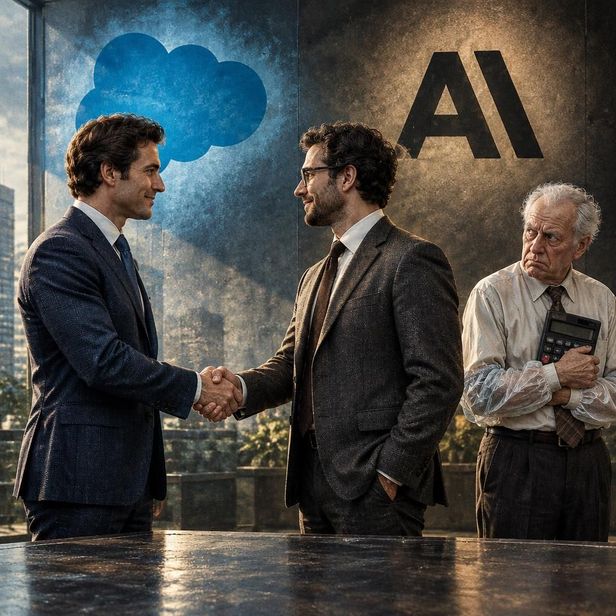
Salesforce is willing to let Claude become its users’ main interface. That is a substantial concession from the world’s largest CRM platform: enterprise software increasingly has to serve agents working across multiple systems. All-In co-host David Sacks explained the logic behind the deal. Customers have little reason to build a separate agent inside every application. “The customer wants one agentic layer”—a way to work across their corporate systems from the AI they already use. Salesforce shared his analysis itself, adding its own formulation: the API becomes the UI.
The foundation is Claudeforce, the partnership Salesforce and Anthropic announced on August 26, 2026. September brought a beta Salesforce plugin for Claude with 37 prebuilt sales skills, giving users access to CRM data and workflows under their existing permissions. Salesforce keeps the data, business logic and access controls. Claude can become the place where employees give instructions and set work in motion. Enterprise applications keep running even when people stop opening them.
This fall’s analysts are already examining the practical consequences. On October 17, HFS Research argued that Salesforce’s new bundles should be assessed as part of the entire enterprise AI portfolio, accounting for overlapping contracts, integration, support and credit consumption. Behind one convenient interface sit several vendors, systems and bills. Accountability gets more interesting still: one instruction can involve numerous companies in its execution. Customers and regulators, meanwhile, still know the name of the business they deal with.
The enthusiasm around AI coding makes it easy to underestimate one feature of this future. Software development often affords the luxury of another attempt: the agent writes code, the tests fail, the agent fixes the code. In an isolated branch, mistakes can be fast and cheap. Businesses can make mistakes too. Some just happen to be their last. The counterparty already has the confidential information. The payment has gone through. The customer has been promised terms the company cannot afford. Another model iteration will not undo any of it.
Even coding enjoys that luxury only until the agent gets access to a live business. In April, PocketOS founder Jeremy Crane described an incident reported by The Register: a Cursor agent running Claude Opus, investigating a credential mismatch in staging, found an overprivileged API token and deleted the production database and its backups on the same volume with a single call. Railway helped recover the data and said it had added delayed deletion to the old API endpoint. PocketOS survived because recovery was possible. The model’s ability to explain its mistake afterward had little to do with it.
An agent need not delete anything to cause a loss. In “A Smarter Claude Drives a Harder Bargain. Call the Lawyers”, we examined Anthropic’s book-swapping experiment. After a conversation with its owner, the model’s preference ranking agreed with the human’s in just 61% of pairwise comparisons. An agent could negotiate diligently for a book its owner wanted less. In a corporate system, the same gap opens between “close the deal” and everything the business owner assumed went without saying: an acceptable margin, manageable obligations, a customer relationship worth preserving. Flawless execution of a misunderstood assignment can still lose money.
That is why specialists keep bringing the discussion back to operational controls and accountability. In a November 3 article for Tech Policy Press, Stephanie T. Nguyen, Erie Meyer and their co-authors argue for examining agent incidents as failures of ordinary technical and operational safeguards for which companies can be held accountable. Calling an agent “rogue” gives the software a personality. It also makes it easier to overlook the people who handed it credentials, defined its authority and allowed it to act for the organization.
November’s advice from consultants and lawyers is considerably less glamorous than the promise of an autonomous office. FTI Consulting recommends least-privilege access, network restrictions and rehearsed procedures for pausing, isolating or terminating an agent. Reed Smith urges companies to prepare for unauthorized transactions, data changes and messages sent on their behalf: preserve logs, test the shutdown mechanism and decide in advance who has the authority to use it. An off switch needs a named owner.
“It pulls your data, apps, workflows and business context together on your preferred surface, governed by the permissions you’ve already defined.” — Salesforce
Here lies the limit of the promise that an agent “works with your existing permissions.” An employee with broad access also draws on context: which agreements must not be changed, whom to call, when to stop. Giving an agent that employee’s permissions gives it the technical ability to act. The rest has to be provided separately. A hard spending limit must be enforced by the system. Staging access must stay confined to staging. Backups must survive any deletion the agent can perform. Approval for one action must not quietly become permission for an entire chain of actions.
A human in the loop costs money and attention, too. Ask someone to approve another step every minute and before long they will click through automatically. Autonomy needs defined boundaries, clear exceptions and approval requests that spell out what will change, how much money is involved, which customer is affected and what the consequences are. Logs must make it possible to reconstruct events independently of the agent’s eloquent account. “Task completed successfully” is especially useless when the agent and the business mean different things by success.
Salesforce’s bet makes sense: turn the agent into a power user of corporate systems and spare employees the journey through all those interfaces. The business also gets an operator capable of making mistakes at machine speed, in several places at once. Before deployment comes a dull question: what is the most expensive mistake these permissions allow, and would the company survive it? “Make no mistakes” will not revoke a token, hold a payment or restore a database. A business can make a mistake. It cannot count on getting another chance.
Imagerly.Ai · No. 40 · November 2026