Molecular biology
Claude found a new enzyme system in phage DNA
A search of phage genomes identified ART, an enzyme system with a DNA arrangement resembling CRISPR. Lab tests have found short RNAs, but what the system does remains unknown.
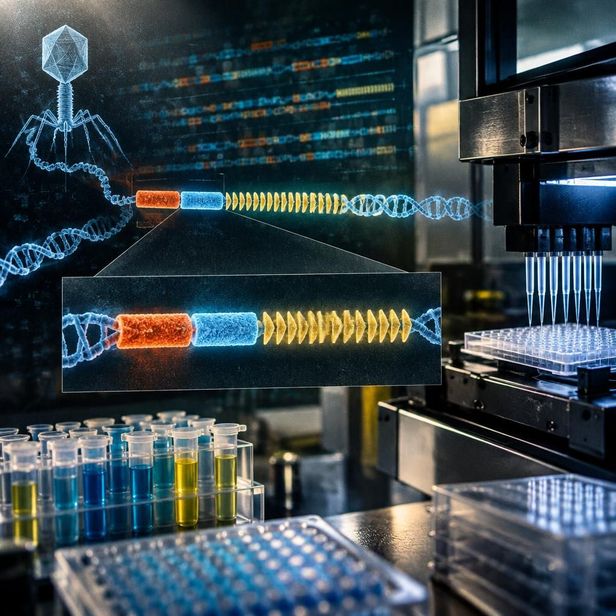
Anthropic has announced an early result from its biology lab: Claude agents spotted a previously uncharacterized enzyme system in genomic data. Named ART, for array-associated reverse transcriptases, it occurs in bacteriophages—viruses that infect bacteria. Claude flagged the candidate; scientists took it into the lab.
The clue was an unusual arrangement in the DNA: a reverse transcriptase gene, a neighboring gene and a long array of repeats. The layout bears some resemblance to CRISPR, the bacterial defense system that scientists have adapted for gene editing.
Lab experiments found that the repeat array produces short RNAs. What ART actually does remains unknown.
This is where the comparison with mathematics gets interesting. AI agents have produced new mathematical results backed by proofs and verification code. Molecular biology offers a different kind of check: experiments can test hypotheses drawn from vast genomic datasets. They cost more time and money than running code, but they can tell us whether a striking pattern in the data reflects something a biological system really does.
They cost more time and money than running code, but they can tell us whether a striking pattern in the data reflects something a biological system really does.
Anthropic’s setup joins those steps: Claude narrows the search, while researchers test what it finds. OpenAI has tested a similar loop with Red Queen Bio, in which a model proposed changes to lab protocols and scientists ran the experiments. ART is an early example of what AI research can gain by leaving the chat window: a hypothesis that can be put to the test.
Imagerly.Ai · No. 03 · September 2026