Orbital computing
Google Can Send TPUs to Orbit. The Economics Are Still Grounded
Project Suncatcher is preparing to test AI chips in space. Whether orbital inference can shed heat and cover its costs is a much larger question.
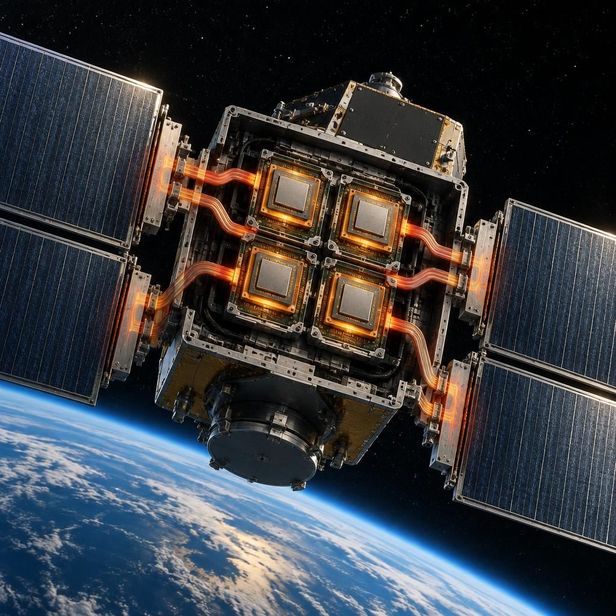
Space-based AI is still at the demonstrator stage. Starcloud says it has run inference on a satellite carrying an NVIDIA H100. Google is next in line: its Project Suncatcher announcement describes a prototype due to launch aboard a SpaceX rocket on October 1. Reporting on the mission says it will carry four of Google’s own TPUs. As of September 25, it has not launched. Even a successful flight would be a test, not an orbital data center.
The useful questions start with the hardware. Can the TPUs survive launch and operate reliably in space? Google has tested them against radiation in the lab, but orbit is where that result gets a proper trial. Then there is the heat. A vacuum will not carry heat away from a chip; the spacecraft must move it to radiators and release it as radiation. More compute means more heat to reject—and potentially larger, heavier cooling hardware.
A vacuum will not carry heat away from a chip; the spacecraft must move it to radiators and release it as radiation.
Google also wants to explore tightly grouped satellites linked at high speed, rather than treating each spacecraft as an isolated computer. That sounds more like a cluster, provided the links work and the satellites can maintain their relative positions reliably. Planet, Google’s partner, has described testing how two prototypes work together as a goal of the program. It remains a goal, not a proven architecture.
And if the engineering works, what does an inference result cost? Google’s case for the idea depends partly on launch prices falling below $200 per kilogram. At that projected price, Google compares the cost of launching and operating an orbital data center with the electricity costs of a ground-based one. That is not a full accounting of orbital inference: spacecraft, radiators, communications, manufacturing, limited lifetimes and replacement launches all matter. One independent estimate puts the annual cost of launching and operating a GPU in orbit at least an order of magnitude above the cost on the ground.
This is no longer just a Musk-and-Starship thought experiment. SpaceX has plans for its own tests; Blue Origin has filed for a computing constellation; Starcloud has demonstrated inference on a satellite; and Google is preparing to test its TPUs with Planet. They are at different stages, and a win for any one experiment will not validate everyone else’s business model. Nobody has yet shown how to make orbital inference pay once launches, cooling and satellite replacement are on the bill.
Imagerly.Ai · No. 02 · September 2026