The launch squeeze
Musk is making room for Starship. The Pentagon needs a ride
Falcon 9 is getting harder to book, rival rockets are running late, and Starship is still in development. The Pentagon gets to bridge the gap.
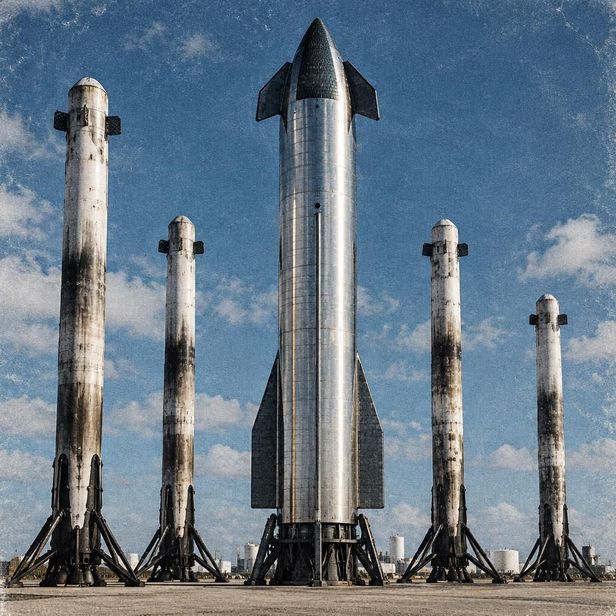
SpaceX appears ready to cannibalize its own launch business to make room for Starship. According to Politico: the U.S. Space Force tried to book three additional launches through the National Security Space Launch program, but SpaceX declined, according to the publication’s sources. No other company offered to take the missions, either. The Pentagon has a basic problem: satellites need launching, and available rides are getting harder to book.
Until now, civilian customers had felt most of the squeeze from the Falcon 9-to-Starship transition. Commercial operators have reported trouble securing Falcon 9 launches beyond 2028; NASA has been booking the last available Crew Dragon slots for future ISS crews. Falcon 9 is still flying, but its planned retirement is already shaping what customers can order years ahead. Being a military customer apparently offers no immunity.
“Some of those firms have been unable to secure Falcon 9 flights after 2028.” — Politico
Those extra Falcon 9 launches were themselves needed to cover delays with Vulcan Centaur. United Launch Alliance (ULA), once the dominant provider of U.S. military launches, has yet to return to flight, forcing the military to move important missions to SpaceX. Every fallback seems to lead back to Musk. A little over a decade ago, SpaceX sued the Air Force for a chance to compete for military launch contracts. Now the military is bringing it extra business, and the company is turning it down.
The alternatives look impressive until dates enter the picture. Early 2027 looks like a realistic prospect for New Glenn’s return to flight after its launchpad explosion, with the necessary Space Force approval process still to clear. Vulcan aims to fly again before the end of 2026, but it, too, needs its military clearance restored. Relativity’s Terran R, Rocket Lab’s Neutron and Stoke’s Nova are all targeting debuts next year, with plenty of scope for further delays. The supplier list is growing. The number of launches available for today’s military requirements has yet to follow.
A successful debut gets a new rocket only so far with the Pentagon. NSSL has two procurement lanes: Lane 1 accepts more launch risk and allows a new provider to compete for orders after one successful orbital flight. Lane 2 covers the most critical missions and requires full certification, including at least two consecutive successful launches and the remaining checks. Counting on these newcomers to close the gap even by the end of 2027 is an optimistic way to plan a military launch schedule.
Starship itself is still in development. As we reported after Flight 14, the vehicle reached orbit for the first time on September 28 and deployed 26 Starlink V3 satellites. That was a substantial engineering achievement. Engine problems nevertheless returned, and the mission ended earlier than planned. There is still considerable distance between that milestone and routinely carrying critical military payloads.
SpaceX is already sharply restricting additional bookings on its proven rocket. That looks a lot like securing demand for the replacement: the fewer Falcon 9 flights customers can buy, the more urgently they need Starship. Cannibalizing an existing product is a perfectly ordinary strategy for a technology company. Here, customers also bear the cost of the transition, waiting for the next generation without a dependable alternative to the old one.
Starship has capabilities the military would be foolish to ignore. Using them will require changes to payload design, including flatpack satellites that can be stacked densely for batch deployment. That approach works well for launching constellations. Adapting existing military spacecraft to it takes engineering; a huge cargo bay does not automatically make every satellite a convenient piece of stackable cargo.
Procurement needs an overhaul, too. Spreading missions among several contractors is supposed to assure access to space. Right now, that roster conceals a shortage of flight-ready rockets. Musk can afford to make room for his next rocket. The Pentagon has to find something to fly on in the meantime.
Imagerly.Ai · No. 25 · October 2026