AI at the bench
OpenAI and Anthropic head into wet labs. The next breakthrough will need test tubes
The models can keep proposing experiments. Reagents, robots and the people running the lab now decide how fast the discoveries arrive.
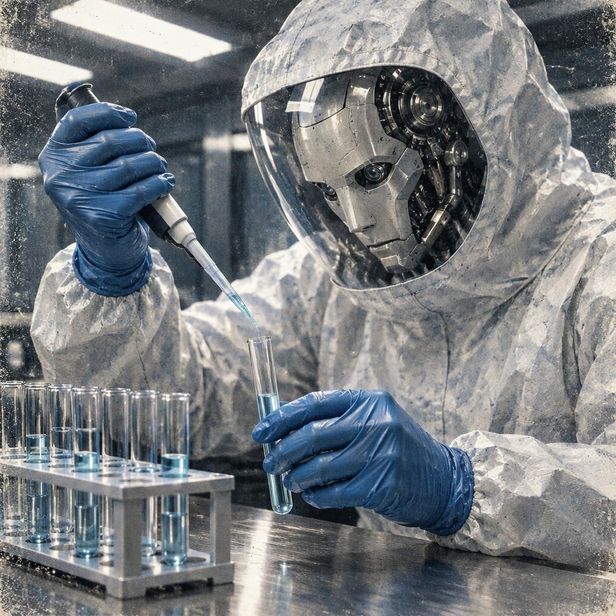
On October 20, OpenAI announced its acquisition of Orchestra Bio, a platform that helps biopharma teams coordinate drug development. Its team and technology will join Rosalind, OpenAI’s life sciences models and tools. The pitch is familiar: get new treatments to patients sooner. Behind it, a tangible operation is taking shape, combining specialized models, scientific software, laboratory experiments and, now, tools to manage the journey from discovery to a finished drug.
OpenAI has spent the year building out Rosalind. It introduced GPT‑Rosalind in April for biology, drug discovery and translational medicine, then took it beyond research preview on September 11, opening access to vetted organizations. Rosalind Workbench brings models, scientific data and research tools into a shared workspace. With support for sequence analysis, genomics, chemistry and experimental planning, OpenAI is steadily making room for AI at the lab bench.
Anthropic is pursuing much the same opportunity. Its acquisition of biotech startup Coefficient Bio emerged in April; The Information and Eric Newcomer put the all-stock deal at roughly $400 million. On September 18, Reuters reported that Anthropic had set up its own wet lab in the San Francisco Bay Area. Eric Kauderer-Abrams, its head of life sciences, confirmed that the company was already conducting physical biology experiments. Reagents and the people who handle them are now part of the Claude developer’s operation.
“We believe that to do biology, the final test is still, and will be for a while, in real lab work.” — Eric Kauderer-Abrams, Anthropic’s head of life sciences
Days later, Anthropic announced the first result from that research: ART, an enzyme system that Claude agents had identified in bacteriophage genomic data. As we reported at the time, the model spotted an unusual arrangement of genes and repeated DNA sequences, which researchers then investigated in the lab. Experiments showed that the repeat array produces short RNAs; the system’s overall function remains unknown. The workflow is already clear: search a vast dataset, formulate a specific hypothesis and test it with biological material.
OpenAI has also taken this feedback loop beyond the slide deck. In December 2025, it described a collaboration with Red Queen Bio in which GPT‑5 proposed changes to experimental protocols, the partner’s researchers ran the experiments, and their findings informed subsequent rounds. In February 2026, OpenAI and Ginkgo Bioworks demonstrated a loop using a robotic laboratory. Across six rounds, the system tested more than 36,000 reaction formulations for cell-free protein synthesis. The companies reported a roughly 40% reduction in the cost of reaction ingredients per gram of the test protein sfGFP. The model proposed experiments; robots carried them out and returned the measurements.
That feedback loop makes experimental biology an attractive candidate for AI’s next breakthrough. A model can generate hypotheses rapidly and use each batch of results to choose the next experiments. The experiment becomes the final “oracle”: was the protein produced, did its activity change, did the predicted effect appear? In some mathematical problems, code or a proof can establish whether a proposed solution works. In biology, each answer consumes reagents and instrument time. However quickly ideas arrive, laboratory capacity sets the pace of testing.
The Orchestra acquisition brings another bottleneck into focus. Drug development involves thousands of interdependent decisions across discovery, preclinical research, manufacturing and clinical development. Even a promising hypothesis can stall while teams sort out plans and resources. OpenAI is buying software to coordinate that chain of work. A model that proposes more useful experiments also creates more work to organize, from running the tests to deciding what happens next.
Together, these announcements show where both companies are placing their next big bet. They are acquiring biotech teams, releasing specialized models and building feedback loops between AI and physical experiments. Biology offers an enormous space to explore and an unforgiving test of what the search is worth. Test tubes don’t care how persuasive an answer sounds. The result has to be reproducible.
Imagerly.Ai · No. 26 · October 2026