AI for science
OpenAI’s math crisis turned into a hackathon
Mathematicians are improving OpenAI’s results before breakfast. The revolution has acquired pull requests, named contributors and a question for the company: can researchers have the tool?
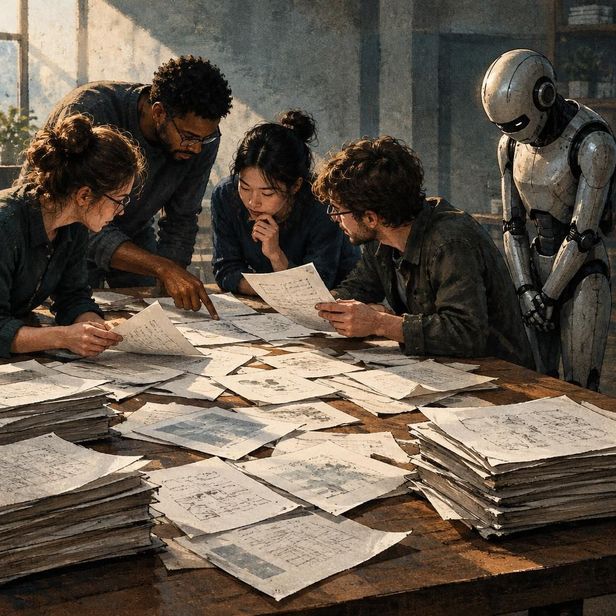
The crisis in mathematics foretold on X has arrived. After OpenAI released its results, mathematicians did what any doomed profession would do: started building on them. OpenAI was counting its agents’ achievements in researcher-years; spectators were waiting for the humans to surrender. The humans opened GitHub. The mathematical spam machine we covered recently had produced both errors and promising ideas. The errors were predictable. What happened to the ideas was much more interesting.
Integer multiplication has supplied the most spectacular example. Among the manuscripts in OpenAI’s repository was a claimed advance in how quickly very large whole numbers could, in principle, be multiplied. It challenged a long-standing conjecture about the best possible speed in a particular theoretical model of computation. The initial gain was microscopic. The machine had found a way through; it had left plenty of room for someone else to widen the opening.
Researchers wasted no time. The first improvements appeared on the day of the release. The next day, estimates kept changing around the clock. By the following morning, Douglas Colkitt announced that he had merged a pull request, producing another enormous leap over the preceding estimate. OpenAI’s tiny initial gain had already been left far behind. The work lives in a community repository, with proofs, certificates and reproducible checks. The refinements still depend on the underlying OpenAI framework. The revolution now has a commit history and named contributors, rather than just a company logo.
“Validated and merged Rohan's PR. Big gain on a really difficult regime (that frankly I was stuck at). Incredible work.” — Douglas Colkitt
That infrastructure makes it possible for a conversation to become research. Someone spots a promising move; someone else recognizes a technique; another contributor repairs the argument or writes a checker. New combinations emerge, along with other problems the technique might help solve. One of the updates describes removing a bottleneck by moving only the information needed to control the calculation, instead of whole blocks of data. OpenAI supplied a large batch of material and a reason to gather around it. The picture of mathematicians guarding their profession against machines becomes rather difficult to sustain when they are racing to improve a machine-generated argument before breakfast.
These leaps concern a theoretical estimate of how the work grows as the numbers get longer. They do not translate directly into faster multiplication on a laptop. Still, the pace invites the joke that by tomorrow it will be free. Even a mathematical apocalypse has to allow time to read the numbers being multiplied. The joke also neatly returns a favorite AI forecasting technique to its senders. Plot the results, extend the line, and announce a brighter tomorrow.
A useful argument in physicist Sabine Hossenfelder’s recent discussion is that much of the value of AI research may lie in finding unexpected uses for established methods from neighboring disciplines. An individual researcher has a specialty, familiar tools and a finite reading history. A model can range across fields and suggest a connection that the specialist might otherwise take years to encounter. Recognizing whether that connection contains useful mathematics, checking it and developing it are research tasks in their own right. A machine-generated starting point can make them possible sooner.
Which makes the practical request to OpenAI fairly straightforward: give researchers the tool. They can judge where it helps and put it to work, without every result having to march through a corporate publicity parade first. For now, the company enjoys a privileged position: it chooses the questions, runs a closed system and presents the output. A mathematician gets the manuscript, which can certainly be useful. Access to a system that could explore connections around that mathematician’s own problem might be far more useful. That requires access to the model, workable verification tools and a clear price for experiments. A spectacular PDF dump does not provide those things.
Two days of public work cannot settle the future of science. They do suggest a hypothesis worth pursuing. Large corporate runs can generate huge amounts of mathematical material; researchers then find ways to strengthen it dramatically, combine it with other methods and take it somewhere else. Put comparable search capabilities on each researcher’s desk, and AI for science could develop into something considerably more interesting than a demonstration of corporate compute. While the prophets debated who would inherit mathematics after the mathematicians, the mathematicians got on with the work.
Of course, a scientific spam machine can also fit on one professor’s desk. In September, The Washington Post reported on Nicholas Polson of the University of Chicago, who had written or co-written more than 200 papers that year with AI assistance. After other researchers raised questions, the preprint platform SSRN removed 257 papers bearing his name. Polson acknowledged using AI and suggested that some of his critics were motivated by envy.
The personal publication factory is already available, then, and it can certainly keep everyone around it busy. An AI research assistant for every scientist is an enticing prospect. Research taste: not included.
P.S. Overnight, the hackathon produced another draft improvement. Its claimed theoretical gain is about 8 times the repository’s current main-branch estimate, according to the community tracker. The humans still haven’t surrendered. We may need more postscripts.
Imagerly.Ai · No. 12 · October 2026