AI-assisted science
Claude Can’t Do Your Science? Change the Science
A flawless calculation can still earn a shrug. Matthew Schwartz’s Claude-shaped research exposes a sharper problem: the discovery accelerator can teach scientists to want only what it can deliver.
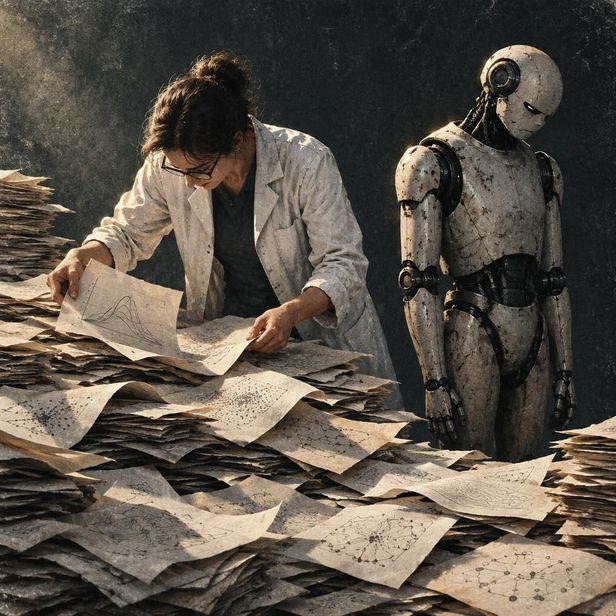
AI-assisted science has found a handy productivity hack: pick research problems the assistant can handle. On October 1, Harvard theoretical physics professor Matthew Schwartz described his approach to “Claude-shaped science”: stop trying to make Claude tackle questions scientists already consider important, and look for questions that suit the model’s strengths. The practical appeal is obvious. So is the awkward question that comes with it: how much science needs trimming before it fits Claude?
Schwartz is considerably blunter about the limitations than the protagonist of an AI-breakthrough story is supposed to be: “The current generation of AI tools is not capable of solving most problems in science.” Models are, however, exceptionally good at certain problems with the right structure. They read papers quickly, write code, connect knowledge across disciplines and apply established mathematical techniques in fields where those techniques have yet to catch on. That is a substantial research programme. Its starting point is the tool’s capabilities. Whether the question matters scientifically remains a separate test.
To support this work, Schwartz built BootLoops, a software harness for exact and high-precision calculations that Claude—or another language model—can operate. Its technical description covers specialised tools for integrals, differential equations, exhaustive enumeration and calculations with controlled error bounds, alongside protocols for checking results. The agent proposes a plan; a human approves it before execution. An analytical expression can be checked against an independent numerical calculation. An exhaustive search can come with a certificate showing that no case was missed.
There is clear value here. A calculation that defeats one discipline may be routine in another; a model can carry the method across a boundary that researchers have struggled to cross. Cheaper computation also makes previously uneconomical questions worth pursuing. Science has always depended on its tools. But the usual ambition of a new telescope or collider is to build an instrument around questions researchers want answered. Once it exists, scientists discover further uses, expanding what they can investigate. Claude-shaped science reverses that sequence: establish what the tool can do, then find questions to fit.
Schwartz’s ecology example makes the distinction painfully clear. Claude and BootLoops solved an equation from neutral biodiversity theory and applied the result to tree census data from Barro Colorado Island. The mix of tree species was changing 4.5 times faster than the theory allowed. A headline practically writes itself: AI exposes dramatic mismatch between theory and nature. Ecologist James O’Dwyer warned that many ecologists would greet it with a shrug. He then helped redirect the work towards a predictive model incorporating additional ecological factors. According to the authors’ manuscript description, that model combines environmental variation, species’ growth, survival and reproduction, and immigration to predict forest dynamics. The crucial correction was to the question.
This was a recurring experience. Schwartz writes that “in almost all cases, Claude was technically correct, but the result was not all that interesting until the expert helped steer us.” Computational verification reaches its limit here: it can establish correctness, but it cannot issue a certificate of significance. In our coverage of the ART enzyme system identified by Claude, experiments with biological material served as the hypothesis’s final “oracle”. Researchers found that the repeat array produces short RNAs; the system’s function remains unknown. Even an experimentally confirmed effect needs a place in a meaningful scientific account. Otherwise, the answer can be impeccable and the discipline entirely unmoved.
“Indeed, I found that in almost all cases, Claude was technically correct, but the result was not all that interesting until the expert helped steer us.” — Matthew Schwartz
Image generation offers a familiar version of this training of desires. Someone starts with a particular image in mind. After enough failed attempts, they learn which compositions, textures and styles the model handles well, then start asking for those from the outset. The images improve. Frustration subsides. Personal taste gradually converges with the generator’s catalogue. Call it prompt mastery if you like; somewhere along the way, the original idea has shrunk. In science, the same bargain shapes questions that may consume months of work.
That is the paradox: AI can expand the range of available solutions within a class of problems while narrowing the research agenda around that class. The pressure grows when fast results become the main measure of success. Questions requiring prolonged observation, uncertain formulation or new concepts lose before the work even begins: they are inconvenient for the assistant. If that selection process becomes embedded in projects, publications and funding, today’s model limitations acquire a vote over tomorrow’s scientific attention.
The boundary between useful gap-filling and an AI-shaped agenda lies in who gets to choose—and revise—the question. Computational tractability is a good reason to investigate an opportunity. “We’ll work out why it matters later” is a much worse research programme. What does the result explain? Which competing explanations can it distinguish? Why should a specialist care? An unexpected finding can certainly become important; science would suffer under a permanently approved list of Millenium Problems, too. But “Claude can do this” tells us something about the choice of method and very little about why the work deserves doing.
Schwartz demonstrates a workable way through: involve specialists who can reframe the problem, even when the first result already looks impressive. They rescue the research from becoming a production line for technical novelties that earn a shrug. His essay could easily become an advertisement for science that has finally learned to fit Claude. The more useful lesson is to keep that fit provisional, with researchers free to change the question or abandon the tool. Otherwise, the promised discovery accelerator will end up teaching scientists to want what it can deliver: more preprints on arXiv, fewer questions too big for Claude.
Imagerly.Ai · No. 10 · October 2026