AI infrastructure
Bring your own power. Pay the neighbors a dividend
Trump wants data centers to power themselves and pay their host communities. For AI investors, winning local support is becoming a line item.
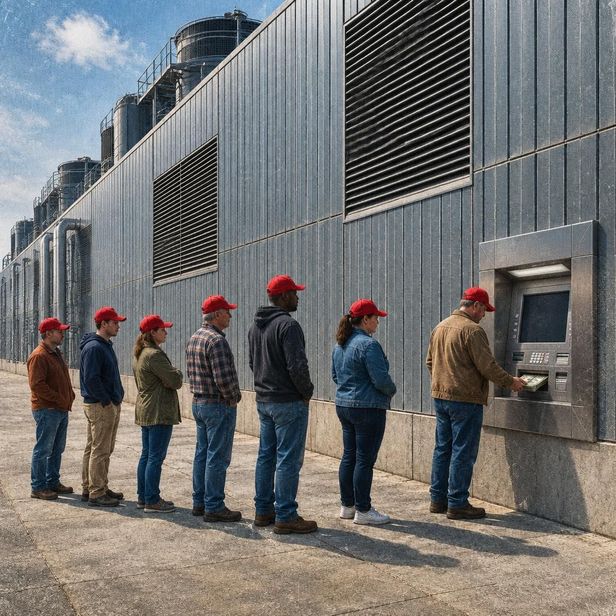
Winning over the neighbors is becoming another cost of the AI boom. In an October 21 Truth Social post, Donald Trump said large new data centers must generate their own electricity and give or sell any surplus to the local community or the grid. He also urged operators to pay host communities or individual residents a “dividend.” The promise of technological progress could use a cash sweetener.
Trump’s reasoning is straightforward: he says he has seen deeply unpopular projects become extremely popular once a financial deal was reached. “MAKE DEALS, and get them built!!!” he wrote. For companies looking for somewhere to put enormous amounts of computing capacity, local opposition becomes something to negotiate over. Residents get to put a price on living next door.
The closest existing agreement is the Ratepayer Protection Pledge, signed on March 4 by Amazon, Google, Meta, Microsoft, OpenAI, Oracle and xAI. The companies promised to build or procure new generating capacity to meet their needs and pay for the necessary grid upgrades. The stated principle is simple: households should not have to subsidize data centers’ appetite for power through their electricity bills.
Enforcement is the weak spot. Experts cited by Renewable Energy World said the pledge was likely unenforceable at the federal level. Protecting customers means turning those broad promises into specific utility rates, contracts and rules for allocating costs at the state level. Signatures from tech companies do not, by themselves, settle who pays for the next grid expansion.
Dividends would take the bargain further. Covering the infrastructure a project needs is a basic cost of building it. Paying the host community offers residents an additional reason to welcome it. Local support acquires a price. Even if an operator pays every cent of the electricity bill for its servers, the neighbors can still ask what the project does for them.
“If companies want to make their Data Centers popular, pay the community, and/or individuals within the community, a ‘dividend.’” — Donald Trump
We have already examined the economics of a $30 billion data center: Bloomberg’s estimate for building and equipping a hypothetical one-gigawatt facility in Texas. More than half the budget goes to chips and server equipment that become outdated much faster than the building. Future revenue already has to cover debt payments, electricity and hardware replacement. If Trump’s proposal turns into actual deals, payments to the neighbors would join that list. The investor pitch will have to account for that bill, too.
The president’s post sets no payment amounts, eligibility rules or mandatory mechanism. It does establish what he wants companies to negotiate. Businesses promising vast economic gains from AI are being asked to share some of those gains with the people living beside the construction site. For residents, a payment would be a lot more useful than another speech about national technological leadership. However grand the promised revolution, the town will expect its money on time.
Imagerly.Ai · No. 24 · October 2026