The infrastructure bill
AI Can Win. Investors Can Lose
Cheap compute could put AI everywhere and still leave its original backers nursing losses. The construction boom has suppliers, lenders and contracts. Who brings the cash that pays them all?
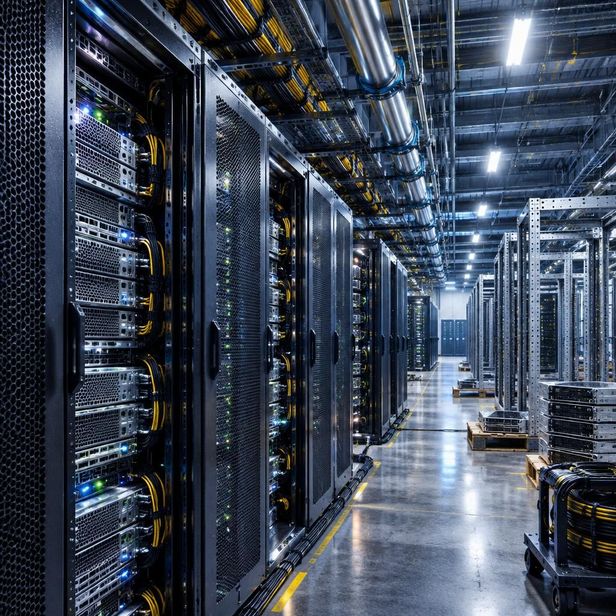
The AI industry knows how much it plans to spend. It has a much harder time explaining how that money will come back. Morgan Stanley forecasts roughly $1.6 trillion in spending by hyperscalers and specialist cloud companies in 2027, followed by $1.8 trillion in 2028. Equipment suppliers, construction firms and power companies see an enormous market. Investors financing the build-out see a claim on future cash flow. Once an accelerator ships, its supplier can book the sale. The buyer still has to earn back the money spent on it.
The Morgan Stanley estimates reported by Summa Money include an important accounting adjustment. For 2027, the bank projects $1.388 trillion in cash capital expenditure, then adds $195 billion to account for operating leases, producing a total of $1.583 trillion. For 2028, the figures are $1.566 trillion and $246 billion, respectively, totaling $1.812 trillion. Leasing secures capacity without requiring an outright purchase of the underlying infrastructure. It still commits the tenant to payments. The lease adjustment in this model, cash capex and the full value of multiyear contracts measure different things. Adding them indiscriminately is an excellent way to manufacture another trillion-dollar boom.
Putting that total next to today's chatbot revenue would tell us little. Capital investment is supposed to generate returns over several years. The infrastructure supports multiple workloads, and hyperscalers earn money from cloud services, advertising, software and much else. AI can pay off through better ad targeting or lower internal costs without anyone buying a subscription labeled AI. The test is whether these uses produce enough additional cash to recover the investment after electricity, operations, interest and recurring equipment upgrades. A customer's productivity gains reach the data center owner only to the extent that the customer agrees to pay for them.
There is substantial revenue already. According to Bloomberg, Anthropic reported $16.8 billion in third-quarter revenue, while OpenAI reached an annualized revenue run rate of roughly $50 billion by late September. Both figures are impressive. Neither establishes that the industry can earn back its infrastructure investment.
A single customer dollar can pass down the supply chain, becoming revenue for a model developer, a cloud provider and an equipment supplier. Each sale belongs in the relevant company's accounts. Counting all three as separate sources of final demand creates money that never entered the system. Investments and loans among industry participants belong in a separate category too. As Reuters reported, in a story published by CNBC, Broadcom agreed to provide Anthropic with up to $42 billion in financing to lease chips. The supplier is helping its customer pay for the supply. That can accelerate construction, but the arrangement ultimately depends on money coming in from users and businesses. Another funding round postpones that test.
Even the giants' existing cash flows are struggling to keep pace with their investment plans. UBP estimates that Microsoft, Amazon, Alphabet, Meta and Oracle will spend about $820 billion on capex in 2026, against $750 billion in operating cash flow. Those figures cover the five companies' entire operations, including their established, profitable businesses. Even with that support, a funding gap remains. Bonds, project loans, joint ventures and leases spread the financing burden across different balance sheets. UBP also puts aggregate off-balance-sheet commitments at nearly $3 trillion, including future leases, purchase commitments and guarantees. Those payments extend over multiple years. When they fall due matters as much as the headline total.
The expected receipts are concentrated too. In its financing analysis, UBP estimates that Microsoft, Amazon, Alphabet and Oracle have $2.3 trillion in contracted future revenue, with about 40% attributable to OpenAI and Anthropic. That makes for a reassuring slide in a lender presentation. Turning the backlog into cash requires customers who can pay. If two model developers account for such a large share of future cloud sales, their commitments cannot also serve as independent evidence of paying demand across the wider economy.
Credit markets are also showing signs of concern. Reuters reported on October 15 that Oracle's five-year credit default swap spread reached 288 basis points, while CoreWeave's exceeded 1,000. CDS spreads are not borrowing rates, but they reveal how the market prices default risk — a signal that can make future financing harder and more expensive. An outstanding fixed-coupon bond does not automatically become more expensive for its issuer. Financing the next project or refinancing existing debt can. Each additional percentage point of annual interest on $100 billion of debt costs another $1 billion a year.
If demand slows, receipts and payment obligations quickly fall out of step. Revenue can miss the plan immediately. Rent, interest and purchase commitments continue on schedule. We examined this problem at Anthropic: according to Reuters' reporting on its confidential IPO prospectus, about 80% of its infrastructure commitments cannot be canceled or require payment regardless of usage. Such contracts protect the supplier against idle capacity by making the customer pay anyway. That protection lasts as long as the customer remains solvent. Once it cannot pay, the risk comes back to counterparties through renegotiations, concessions and restructuring.
“The AI lab said in the prospectus that about 80% of that sum is non-cancelable or requires payment regardless of usage” — Reuters, September 29, 2026
Falling inference prices create a more awkward possibility: AI usage keeps growing while the equipment owner's economics deteriorate. If the price per unit of compute falls by half, the volume sold must double just to preserve revenue. There is no guarantee that demand will grow that fast. The number of economically valuable tasks is not the same thing as the number of tokens an industry can generate. If the cost per unit stays unchanged, less cash is left over. New chips and software improvements can lower those costs, but competition may quickly pass the savings to customers. Billions of additional requests therefore prove little about the return on the infrastructure. A lender needs cash left after those requests have been served.
Faster technical progress brings another bill. In our analysis of a hypothetical $30 billion data center, chips and server equipment accounted for more than half the estimated cost. A building can last for decades; accelerators can lose their economic appeal much sooner. Their physical service life is another uncertainty, especially for new generations of hardware that have not yet accumulated years of operating history. When a newer generation does the same work more cheaply, older hardware must compete on price or move to less lucrative workloads. Operators can keep squeezing cash out of an aging fleet or invest again before recovering their original outlay. Extending an asset's accounting life reduces depreciation expense and boosts reported earnings. It does not fund the next GPU purchase when replacement becomes necessary.
Who pays depends on how the investment performs. With strong utilization at profitable prices, customers gradually cover the construction bill, while hyperscalers can fund some spending with profits from other businesses. If the investment disappoints, shareholders take the first hit through lower earnings, falling valuations and dilution from fresh financing. Leases and guarantees determine how the remaining burden is shared. Defaults pass losses to banks, credit funds and bondholders according to their collateral and seniority. Selling GPUs can recover some money. In a broad capacity glut, however, the collateral's resale value can fall alongside the income it generates.
Mass adoption of AI is entirely compatible with a collapse in returns on some of its infrastructure. Cheaper compute opens up new uses. Consumers get useful services; businesses gain new ways to operate, including changes to how they hire and deploy labor. After write-downs and restructurings, data centers can keep running under owners who bought them for far less. Profitable operation at that lower purchase price will not reimburse the investors who funded the original budget. Today's investors face an uncomfortable possibility: the world may end up needing AI everywhere — just not at prices that repay the people who built it.
Imagerly.Ai · No. 21 · October 2026