The cost of compute
A $30 Billion Data Center. The Chips Will Age First
Fast-aging chips, GPU-backed loans and contracts that keep charging even when demand disappoints: inside the race to earn back AI’s construction bill before the next hardware cycle.
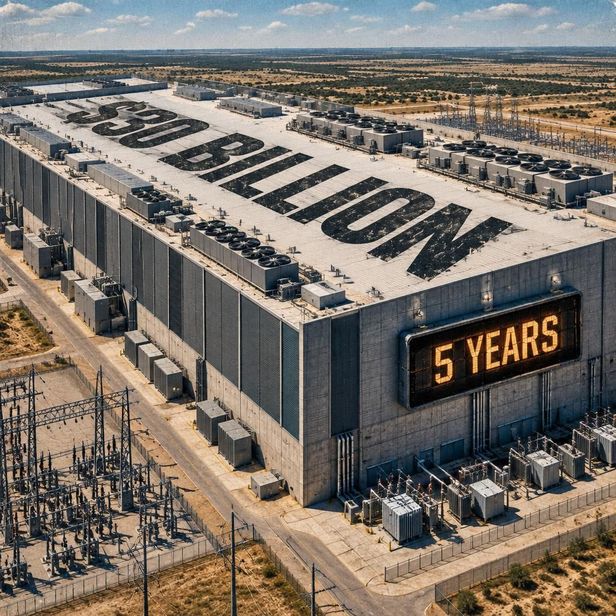
Building and equipping a hypothetical one-gigawatt AI data center in Abilene, Texas, would cost about $30 billion, according to Bloomberg’s breakdown. Chips and server hardware, including racks and associated systems, account for $17.1 billion. Power infrastructure adds roughly $3 billion; construction, another $2.4 billion. More than half the budget goes toward equipment whose economic life is much shorter than the building’s. The next big bill deserves a place on the agenda from day one.
At this scale, the buildout reaches far beyond any individual technology bet. Bloomberg puts combined capital spending by Meta, Amazon, Microsoft and Alphabet at about $750 billion in 2026. That covers their total capital expenditures, a substantial share of which goes toward AI infrastructure. Every new site gets a ribbon-cutting. Earning back the investment is a less ceremonial affair.
The building and its processors run on different clocks. The structure and some of its supporting infrastructure are built for long service. Accelerators have a shorter window in which they can deliver attractive returns from selling compute. A GPU can keep working perfectly while its successor does the same job more cheaply and uses less electricity. The operator then has to cut prices, find less demanding workloads or replace the hardware. A server that still works can be a lousy investment.
That gives the depreciation debate a very tangible price tag. Effective January 2025, Meta extended the estimated useful life of most servers and network assets to 5.5 years. Its annual report says the change reduced that year’s depreciation expense by $2.92 billion. Amazon went the other way for some server and networking equipment, shortening its estimate from six years to five because of faster technological development, particularly in AI. These categories cover more than GPUs, but they show how sensitive reported earnings are to useful-life assumptions. A longer schedule spreads the expense over more years. It puts no extra cash aside for the next round of chips.
The test of whether a data center pays for itself is mundane: how much cash remains from selling compute after electricity, operations, debt service and equipment replacement? High utilization alone answers very little. The price paid for those hours matters just as much. EBITDA excludes depreciation, too. For a heavily indebted business running expensive, fast-aging equipment, that leaves a substantial part of the economics out of view.
Credit lets operators build faster than their own cash generation would allow. It also brings mandatory payments and refinancing risk. CoreWeave’s 2025 annual report, for example, describes credit facilities whose borrowing limits are linked to the cost of the GPU servers being financed, with collateral drawn from the relevant subsidiaries’ assets. The same machines generate revenue and underpin the financing. If their economics deteriorate, both the operator’s revenue and the value of its collateral can suffer.
Circular financing adds another layer: industry players invest in one another, lend to customers and sell them computing capacity. In a recent Reuters report published by CNBC, Broadcom agreed to provide Anthropic with up to $42 billion to finance chip leases. The proposed convertible financing could cover roughly a third of Anthropic’s $125.2 billion commitment under a five-year lease arrangement. The supplier helps its customer pay for the product. That accelerates sales, but supplier, customer and lender all depend on the same forecast coming true: enough paying demand must materialize at the end of the chain.
Long-term contracts let companies shift some of the risk of idle capacity onto one another. We have examined this through Anthropic’s commitments. According to Reuters, citing its confidential IPO prospectus, about 80% of the infrastructure commitments in a spending program of at least $518 billion over roughly a decade are either noncancelable or payable regardless of usage. That protects the supplier’s revenue. It leaves the buyer paying even if sales grow more slowly than planned. The sales forecast can slip. The server bill still comes due.
Who ultimately bears the financial risk depends on the deal. The operator’s shareholders take the first hit to the value of the business. Mandatory lease payments can shift the cost of unused capacity to the customer; a guarantee can put a guarantor on the hook as well. If the borrower stops paying, losses reach banks, credit funds and bondholders according to their collateral and priority of claims. A building full of GPUs can help recover some of the money. How much depends on what buyers will pay when the assets are sold—and how much value the equipment has lost by then.
“Global Crossing's plan of reorganization included the cancellation of existing preferred and common stock.” — Global Crossing, quoted by Light Reading
The railroad and telecom booms showed how a technological revolution can coexist with financial ruin for the people who funded its first infrastructure. Global Crossing filed for bankruptcy in January 2002, during the dot-com bust, with about $12.4 billion in debt. Its network survived restructuring. Its old shareholders lost their stakes. The infrastructure proved useful to the internet, but that usefulness did not repay the original investors. AI construction comes with an added complication: a large share of the investment goes into equipment that can lose its competitive edge far faster than installed fiber.
After a debt write-down or a change of ownership, the infrastructure could become a bargain: the next owner has a lower purchase price to earn back. A data center’s eventual success therefore says little by itself about the wisdom of today’s construction budget. The investment case needs answers to three questions: how much end customers pay, what it costs to keep the hardware competitive, and who covers the shortfall if the numbers fail to add up. AI may well change the world. The lender still expects to be paid.
Imagerly.Ai · No. 19 · October 2026