The price of progress
Moore’s Law Is Running Backwards—and Transistors Are Getting Pricier
AI’s promise of cheaper computation is colliding with a hardware market moving the other way. The old discount from miniaturization has faded just as demand for memory and advanced packaging explodes.
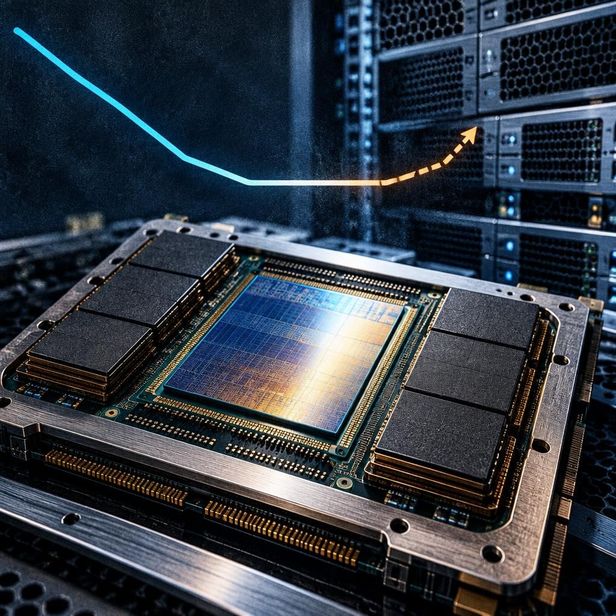
Exponential View has flagged a shift that challenges one of the tech industry’s default assumptions: the same money will buy more transistors next year. The effective price per transistor has stopped falling, and its 2026 forecast puts it 52% above the 2022 level. The economic promise associated with Moore’s Law—steadily cheaper transistors—is starting to run in reverse.
The historical numbers show just how big a departure this is. In 1955, a single transistor cost $4.76. By 2000, that had fallen to $0.00000065. In 2022, the effective price was roughly 29 cents per billion transistors. It dropped in 2023, then flattened out. The forecast for 2026 is 44 cents per billion. After decades of extraordinary price declines, the trajectory now points up.
The warnings go back years. During the debate over moving beyond 28nm, analysts identified that node as the point where the old manufacturing economics began to break down. An EE Times review cited IBS estimates showing that a transistor at 10nm cost less than at 14–16nm, but more than at 28nm. Engineers kept packing transistors more densely; the customary price cut with each generation was no longer guaranteed. More expensive fabs, equipment and increasingly complex production processes were eating into the savings from miniaturization.
Then came the AI boom. Accelerators need leading-edge silicon, high-bandwidth memory and advanced packaging. Inference adds growing demand for storage. Manufacturers are steering capacity and investment toward the strongest demand and the customers with the deepest pockets. In its 2026 forecast, WSTS projects roughly 250% growth in memory revenue, explicitly naming AI infrastructure and HBM among the main drivers. It looks like a perfect storm: the old engine of cost reduction is losing steam just as the world’s biggest companies bring their budgets to bear on limited supply.
The transistor has stopped getting cheaper
Exponential View’s measure captures the economics of that market. It divides semiconductor industry revenue by the estimated number of transistors shipped, so manufacturing costs, markups and a sales mix tilted toward expensive products all feed into the result. The historical TechInsights / IEEE Spectrum series is extended from 2022 onward by an independent reconstruction using a different methodology, and the 2026 figure remains a forecast. What the measure tracks is how much revenue the industry collects per transistor shipped.
For decades, tech companies could count on time to do some of the work. The next generation of hardware would deliver more capability per dollar, helping make products viable that were too expensive today. AI is pushing demand harder just as that dependable help stops arriving. Cheaper useful computation will have to be earned through better architectures, specialization and more efficient software. Progress is moving from demos to economics—and the hardware bill is going up.
Imagerly.Ai · No. 15 · October 2026