Neuroscience meets the internet
I Have No Wings and I Must Buzz: Why Developers Are Making a Fly Brain Play Doom and Trade Bitcoin
An open map of a fruit fly’s nervous system has become an unlikely playground for programmers. The experiments are real; the digital fly is not.
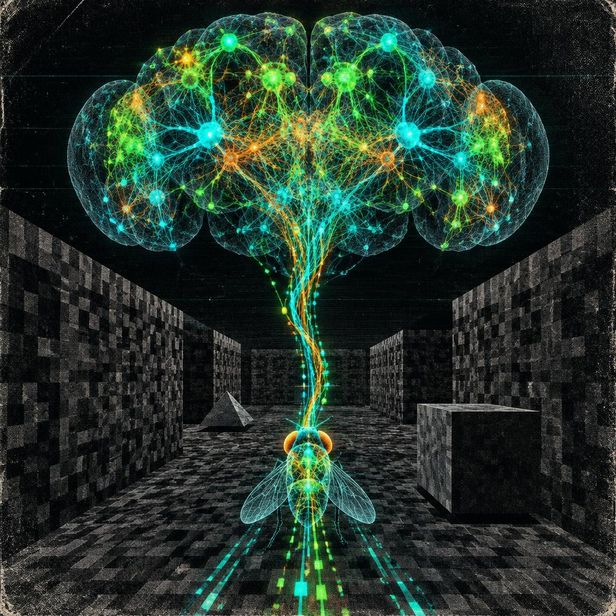
Give a fly brain a Doom-like maze. Show it a BTC–USDC chart. Put it in a virtual body and see what happens. The internet has found a new use for a fruit fly’s nervous system: connecting a detailed map of its wiring to things no fly evolved to do. The meme calls it “I Have No Wings and I Must Buzz,” a riff on Harlan Ellison’s I Have No Mouth, and I Must Scream. The joke works because there is real research beneath it—and a great deal of engineering between the research and the spectacle.
The starting point is MaleCNS v1.0, an open connectome of the central nervous system of one adult male Drosophila melanogaster. It covers the central brain, optic lobes and ventral nerve cord. Public descriptions count more than 166,000 neurons and over 100 million synapses, although synapse totals vary with the version and representation of the data. Built by FlyEM at HHMI Janelia with collaborators at Cambridge, the MRC Laboratory of Molecular Biology and Google Research, the dataset was released in June 2026; its accompanying Cell paper appeared in September.
For neuroscientists, this is a way to investigate cells and circuits at extraordinary resolution. For programmers, it is also an immense graph with missing instructions. What should enter as sensory input? How should activity propagate? Which signals should become a turn, a step or a button press? The connectome supplies the wiring; programmers decide what counts as sight, movement or a trade.
The connectome supplies the wiring; programmers decide what counts as sight, movement or a trade.
In Stonkfly, Coinbase engineer Alex Wormuth turned BTC–USDC market data into a visual input for a simulation and mapped its output to three actions: buy, sell or do nothing. Reports described a $100 starting balance and an early gain of roughly $1; later results also included a loss. Neither outcome makes a fruit fly a trader. The interesting part is the interface, not a proven investment strategy.
Other projects give the wiring a body. FLYBRAIN and open simulations couple the connectome to virtual sensory inputs and a physical fly model, translating activity in motor populations into movement. Doom and other game-world demonstrations take that idea further. They are striking demonstrations of a constructed sensorimotor loop, not proof that a complete fly has been recreated in software. The meme’s longer list of challenges should not be read as a catalogue of verified projects.
A connectome is not a recording of thoughts, and it cannot run itself. It shows which cells were connected in a particular animal; it does not, on its own, supply all the synaptic strengths, biochemistry, plasticity, signal dynamics or bodily conditions needed to reproduce a living fly. Each playable or trading version adds choices about neuron models, sensory encoding and motor output.
That gap is the point of the craze. Scientists made an unusually detailed nervous-system map available. Developers are testing how far they can push it by building interfaces around it. The resulting fly may enter a maze or place a trade, but what we are watching is as much an experiment in human design as one in insect neuroscience.
Imagerly.Ai · No. 01 · September 2026