The price of the boom
China’s $480 Billion AI Sell-Off Is a Warning for Wall Street
China’s AI labs are delivering. Its shareholders are discovering how little that guarantees. Wall Street is financing a much bigger version of the same bet.
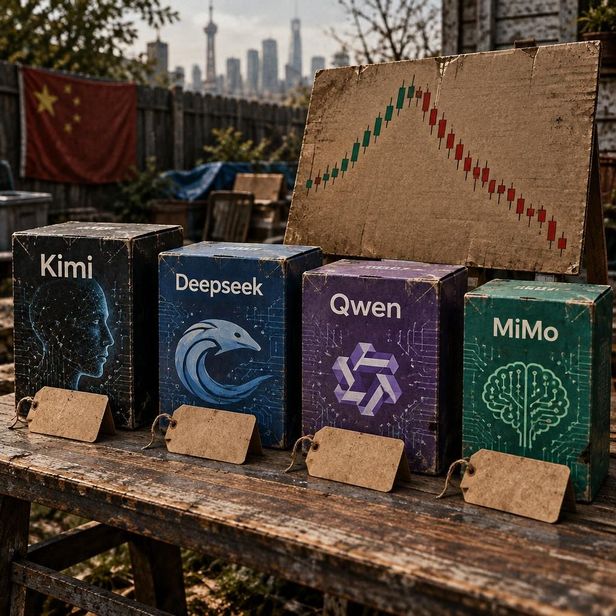
Chinese stocks are enduring their longest run of weekly losses on record. By October 26, the broad CSI 300 index stood at 4,103.54, roughly 20% below its June highs. Technology stocks have fared considerably worse: the STAR50 has fallen about 40% in less than four months, wiping roughly $480 billion off the value of its constituent companies, according to Reuters. Investors who paid in advance for an AI-powered future are taking a steep haircut.
China’s AI labs are still delivering competitive models. DeepSeek, MiMo, GLM, Hy, MiniMax, Kimi and Qwen challenge American leaders on performance, price and access to model weights. Developers have more ways to build AI into their products and fewer reasons to pay a premium for a familiar name. The investment case demands rather more. Investors piled into chipmakers, equipment suppliers and the rest of the AI supply chain expecting enormous future earnings. A strong model leaves plenty of work to do before all those shareholders get paid.
Competition makes that gap harder to close. With several labs offering comparable results, customers can negotiate, switch providers or run an open-weight model themselves. Lower prices encourage adoption while cutting the revenue a provider earns from each request. Maintaining sales requires more volume; justifying an expensive stock requires faster growth still. Buyers of machine intelligence get a better deal. Shareholders get a more demanding set of assumptions.
“The surging global demand for AI and rising costs across the supply chain have led to significantly higher procurement costs for core hardware.” — Alibaba Cloud, March 18, 2026
Company accounts show how much of the boom survives the cost of delivering it. MiniMax’s revenue rose 283% to $116.6 million in the first half of 2026, while its gross margin improved from 12.1% to 17.9%. Even after that improvement, less than $18 of every $100 in sales remained to cover research, development, sales and other operating expenses. Infrastructure costs offer little relief. Alibaba Cloud announced price increases for selected computing and storage services from April 18, citing higher hardware and supply-chain costs. The server bill has not joined the price war.
Politics adds another squeeze. Reuters identified the risk that the US and other countries could ban Chinese data-center equipment, alongside possible restrictions on Chinese optical components supplied to American data centers. Manufacturers could lose access to markets already counted on in their sales forecasts. That is an awkward adjustment for shareholders who have paid for international expansion and must now work out where a company will be allowed to sell. Traders pointed to no single trigger for the rout. Stretched valuations, doubts about demand, tax payments and trade risks were enough.
America’s AI boom has much deeper financial backing. Its cloud giants have profitable existing businesses, vast budgets and ready access to capital. They can build capacity ahead of demand and wait longer for a return. Their commitments also make mistakes more expensive. OpenAI’s contract with Oracle, for example, involves roughly $300 billion in computing capacity over about five years. One company’s order book is another company’s future bills. Ultimately, customers must spend enough to cover computing, electricity, equipment replacement and a profit for the businesses involved.
Wall Street has already shown how violently it can react when those expectations change. In our coverage of October’s sell-off, the US market lost about $500 billion in value as investors learned that OpenAI’s annualized revenue was approaching $50 billion, rather than the widely circulated $70 billion. Both figures extrapolated current sales over a year, and the discrepancy came from differences in accounting. Share prices had already absorbed the more flattering number. An accounting clarification quickly became a repricing of the infrastructure built around it.
China’s correction offers a preview of how the next stage could unfold. AI demand keeps growing, models improve and usage gets cheaper, yet profits fall short of expectations. Labs bargain harder over computing costs, cloud providers reconsider expansion plans and equipment suppliers receive less generous orders. Growth only has to undershoot what share prices already assume for valuations to come down. That is a particular problem when the hardware can age faster than an investment pitch turns into free cash flow.
The Chinese sell-off is an early warning for Wall Street: technological progress can continue while investors lose hundreds of billions of dollars. American companies have larger financial cushions, but they are also funding a much bigger buildout. AI can fulfill the engineers’ promises and still disappoint the people who bought the stocks. Eventually, the profits have to justify the price.
Imagerly.Ai · No. 30 · October 2026