The trillion-dollar bargaining table
Anthropic’s IPO prospectus is out. Even the bulls want a discount
A $700 billion gap separates faith in Anthropic from the price one backer wants to pay. Bulls and skeptics work through the growth, margins and compute bills behind the trillion-dollar bet.
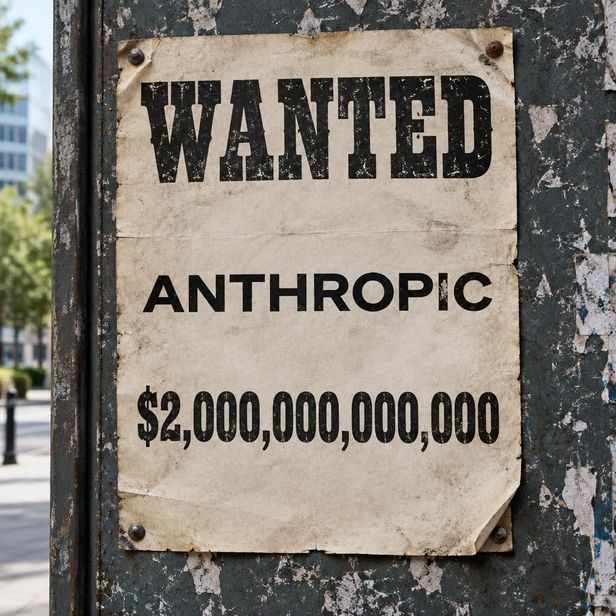
Claude developer Anthropic published its IPO prospectus on October 26. It plans to list on Nasdaq under the ticker ANT, though the share count and indicative price range remain blank. Those blanks have already prompted plenty of haggling. Earlier expectations were around $2 trillion; some investors have been discussing $1.5 trillion. One existing backer would prefer $1.3–1.5 trillion—even though he thinks $2 trillion is defensible. Believing in AI is perfectly compatible with wanting to buy it at a discount.
The $1.5 trillion figure has gained traction in the initial coverage of the filing, including Nate Wolf’s analysis for Barron’s. Its origins predate the public prospectus: Reuters reported on October 15 that some existing and prospective investors had discussed that valuation after Anthropic’s investor day, down from earlier expectations of $2 trillion. We have already covered those negotiations. The filing arrived while expectations were being revised. Much of the substantive commentary, too, had already taken shape around leaked financials and meetings with the company.
The most revealing position belongs to Jared Carmel, co-founder of Manhattan Venture Partners, an Anthropic investor. Speaking to Yahoo Finance on October 23, he separated what the company might be worth from where its IPO should be priced. “I don’t think $2 trillion is crazy,” he said, pointing to the surge in revenue. His team’s preferred IPO valuation was $1.3–1.5 trillion. That leaves as much as $700 billion between what a believer thinks the business could be worth and what he would like buyers to pay.
At the most bullish end sits Dan Ives, a partner at Yorkville Ives. Discussing the leaked prospectus figures on September 29, he compared investing in Anthropic to building the Las Vegas Strip in 1955. In his telling, the infrastructure boom is only beginning, with Anthropic and OpenAI the “heart and lungs” of the AI revolution. He defended the possibility of a $2 trillion valuation as a bet on the scale of the coming economy, without offering a price target of his own. Today’s spending buys a place on tomorrow’s Strip. The casinos still have to get built, and the customers have to spend.
NYU Stern finance professor Aswath Damodaran offered a more demanding version of that future on October 22. In his analysis of Anthropic’s pricing and valuation metrics, he outlined what could make $1.5–2 trillion defensible: exceptionally fast early growth, operating margins of at least 30%, compute costs rising more slowly than revenue, and declining risk as the business matures. He did not calculate his own intrinsic value in that post, published before the public prospectus. His argument brings some discipline to the trillion-dollar discussion: growth, margins, economies of scale and a less threatening regulatory environment all have to come together.
Dario Amodei is quite specific about the competition. The prospectus identifies Alphabet and OpenAI Group as Anthropic’s main rivals among companies developing frontier models for third-party software developers and enterprise customers. Alphabet also supplies Anthropic with computing capacity through Google Cloud. Reaching the 30%-plus operating margins in Damodaran’s scenario will involve fighting for customers against a company Anthropic pays to run its models.
The committed skeptics have much harsher arithmetic. On October 6, New Constructs senior investment analyst Kyle Guske called the offering “the most ridiculous IPO of 2026”. The firm’s reverse discounted cash flow model asked what results would justify $2 trillion: roughly $3.6 trillion in annual revenue and $358 billion in net operating profit after tax by 2035. Under less optimistic assumptions, the model yielded much lower equity valuations: $1.1 trillion and $144 billion. The gap is instructive. After the same explosive start, revenue grows at a compound annual rate of 36% or 20%, respectively, from 2028 through 2035, with after-tax operating margins gradually reaching 20%. Even the $144 billion scenario assumes revenue rises elevenfold in 2026 and doubles in 2027. That low valuation already gives Anthropic enormous credit for the next two years.
Anthropic’s headline first-half net loss of $80.7 billion, however, makes a poor shortcut to an everything-is-doomed argument About $72 billion came from revaluing convertible notes and other financial instruments: a rising company valuation inflated its reported loss. Treating the entire sum as cash burned would be an accounting trick in reverse. Future payments pose the harder question. Reuters reported infrastructure commitments of at least $518 billion, roughly 80% of which were either noncancelable or payable regardless of capacity usage. Slower sales could knock down the share valuation long before they bring down those bills.
The scale of the bargaining is visible without a complicated model. Anthropic told investors it generated $16.8 billion in third-quarter revenue. Multiply that by four and the annualized pace is $67.2 billion. A $2 trillion valuation is roughly 30 times that figure; $1.5 trillion is 22 times; $1.3 trillion is 19 times. This is a rough comparison, not a full-year revenue forecast. It still explains the nerves. Even the bottom of Carmel’s preferred range asks buyers to pay almost 20 times annualized sales, before accounting for expenses. A discount of hundreds of billions still leaves a very expensive future.
That is the mood among the people following Anthropic closely. Ives sees a new economy under construction. Carmel can entertain a $2 trillion value while wanting an IPO at $1.3–1.5 trillion. Damodaran sets demanding conditions, and New Constructs shows how far the valuation can fall when growth assumptions become less spectacular. There is no consensus price. There is, however, a telling point of agreement: even some of the bulls want the seller to fund their margin for error. Faith in the AI revolution remains strong. The appetite to buy it at any price is considerably weaker.
Imagerly.Ai · No. 28 · October 2026