Europe’s launch race
Spectrum Reaches Orbit as Europe Bets on Commercial Launches
Isar Aerospace has delivered satellites to orbit on Spectrum’s second flight. Now Europe’s experiment in backing competing launch providers faces the harder test: making success routine.
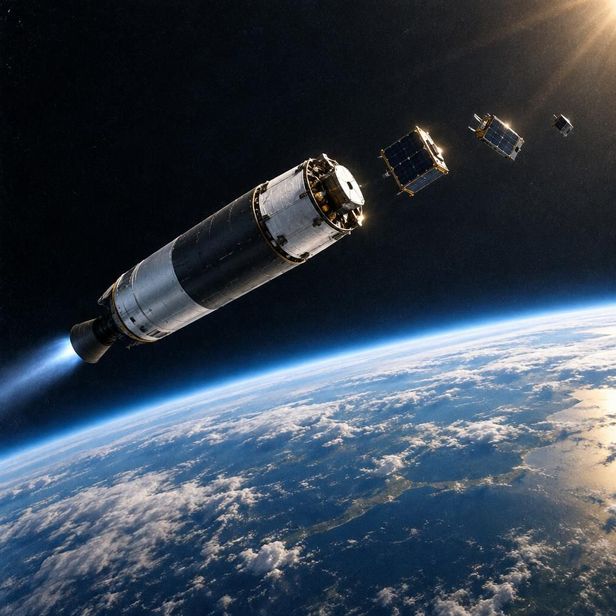
Europe’s space industry has a result to talk about, not just a plan. On 5 September, Germany’s Isar Aerospace launched its Spectrum rocket from Andøya Spaceport in Norway. The mission, Onward and Upward, reached orbit and deployed its payloads. This was only Spectrum’s second flight—and its first with satellites aboard. For Europe’s young private launch industry, the leap from a short test flight to delivering spacecraft to orbit is a big one.
The story goes beyond a single successful mission. Isar Aerospace is one of the companies selected for the European Launcher Challenge, a new European Space Agency programme. Its approach breaks with the familiar model of governments spending years developing one major rocket, then trying to find enough customers to keep it flying. ESA wants to buy launch services from several commercial providers, giving customers more choice and making Europe’s access to space more resilient.
In that sense, Onward and Upward offers an early sign that the approach could work—but the distinction matters. The flight was supported by ESA’s Boost! programme and Germany’s microlauncher competition; it was not a mission flown under a European Launcher Challenge contract. Reaching orbit was nevertheless a crucial milestone for the Challenge. Isar became the first of its selected companies to demonstrate the capability at the heart of the programme: delivering payloads to orbit.
The European Launcher Challenge is not a contest for the best slide deck. It is a test of who can build a working launch service. The five preselected companies are Isar Aerospace, MaiaSpace, Orbex, PLD Space and Rocket Factory Augsburg. They are expected to turn their rockets into regular operations, flying ESA missions in 2026–2030 and demonstrating growing capability. Europe is betting on several independent routes to orbit rather than one national champion.
Isar already has substantial backing. Its contract with ESA under the Challenge is worth about €200 million. The funding is meant to help develop the service around the rocket: infrastructure, testing, a faster launch cadence and future missions. In other words, Europe is funding not one spectacular launch, but the ability to repeat it.
Europe is funding not one spectacular launch, but the ability to repeat it.
Repeatability is now the real test. Spectrum’s second flight was a historic success for Isar, but it did not make the rocket business easy. The vehicle must prove reliable, production must scale, and the launch site and team must be ready to fly regularly. Its competitors face the same challenge. Still, 5 September gave Europe’s strategy something concrete to point to: a private rocket launched from Europe had delivered satellites to orbit.
That may sound like an industry story, but the consequences are practical. More homegrown launch operators could give Europe faster, more independent ways to deploy communications satellites, Earth-observation systems, navigation services and scientific missions. Onward and Upward is not the end of the story, or an automatic victory for the European Launcher Challenge. It is the moment a new policy began to look less like a programme on paper and more like a bright point in orbit.
Imagerly.Ai · No. 05 · September 2026